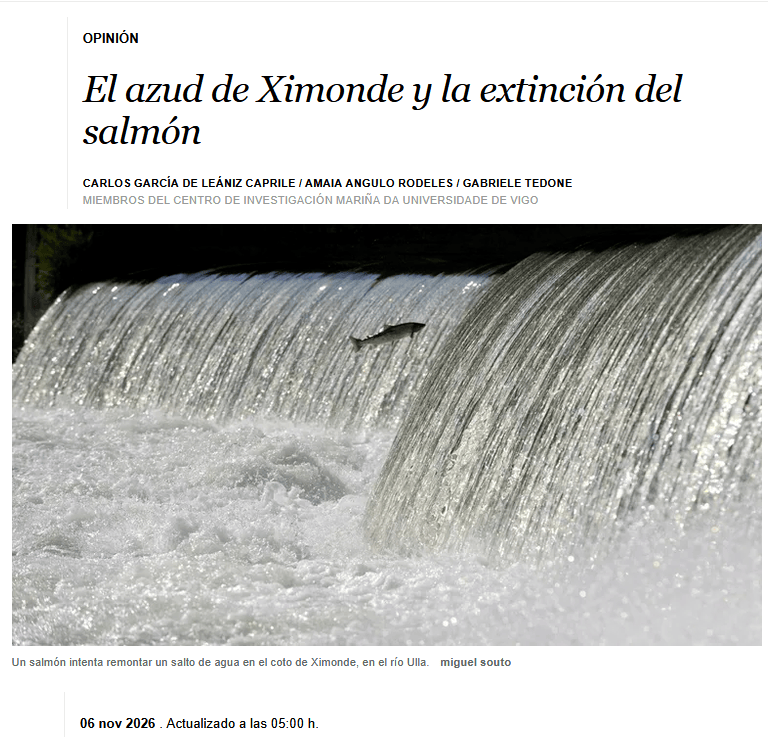
Last Friday, we published an article on Galicia’s newspaper, La Voz de Galicia, on why the Ximonde weir must be removed and not rebuilt.
Link to the original article: https://www.lavozdegalicia.es/noticia/opinion/2026/11/06/azud-ximonde-extincion-salmon/0003_202611G6P14993.htm
English Translation:
The Ulla River has three weirs downstream from the Portodemouros dam (Sinde, Couso, and Ximonde) that delimit the salmon fishing beats. These are ancient lamprey and salmon fisheries, operating without administrative concessions, which the administration has maintained for decades solely to facilitate fishing. Salmon and other migratory fish can only get past them during major floods. They were unblushingly called “retention dams.”
Over time they deteriorate, but some insist on rebuilding them. In 1993, after the fishing season had closed (permits had been sold “with sluice gates”), a gap was opened in the Sinde weir, which we took advantage of to enlarge and make it easier for fish to pass. It was plugged up in 2004 “because the fish wouldn’t stop and that way you can’t catch them.” In 2005, a fish ladder was built in Couso (Xirimbao), and since then not a single salmon has been caught in that beat.
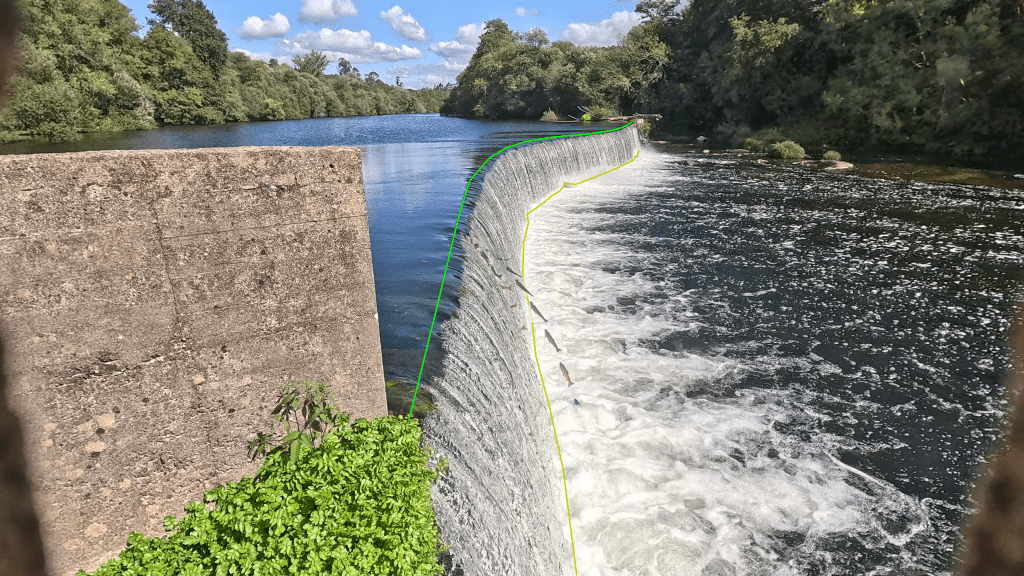
Now it’s Ximonde‘s turn, whose left bank began opening up in 2024 and was enlarged by the floods of this past winter. Once again, there are those calling to rebuild it—to close it—precisely so that the fish cannot pass. Investments have been made in costly fish passes, which are not always effective, when the most effective thing—and what the law mandates—would have been to tear down these obsolete structures of doubtful legality.
Rebuilding Ximonde has no justification and does not benefit the river. The only beneficiaries are those who fish below the weir, and not even them, since there are hardly any salmon left to catch. Even so, it remains an impassable barrier for the few that survive: in 77 hours of recording between July 2025 and February 2026, we counted 374 attempts to surmount the obstacle by trout, sea trout, salmon, and bogue. How many made it past the obstacle? None.
It will be said that more data is needed. It is true that there is a counter at the Couso fish ladder and that the Ximonde trap station has provided very valuable information—perhaps the best in Spain—which has allowed technicians to rigorously analyze the decline of the salmon. But it confirms what we already knew: the salmon is going extinct. The causes are well known: the five “Cs”—loss of connectivity, pollution, water abstractions, climate, and catches—along with complacency and comfort. Maintaining capture traps and counters while the species is dying is writing panegyric science, lines for the epitaph. More data is no substitute for decisions, and knowledge cannot simply be incremental, nor limited to noting the disappearance of the species we want to conserve.
Perhaps the salmon is already functionally extinct and it is too late; the situation at sea does not help either. But that does not justify sitting back with crossed arms or perpetuating outdated solutions (stocking, fighting poachers, killing the predator) that pass the buck: with salmon, it’s always someone else’s fault. Now more than ever, coherent and decisive actions are needed in the rivers, which is where we can take action. The Ulla salmon is being killed by indifference; let’s not let absurd walls finish it off as well.
Please, tear down the weirs of Ximonde, Couso, and Sinde. Do not waste public money on maintaining walls in the river: invest in opening them up. Preserve the old mill of Ximonde, yes, but not the weir that the salmon crashes against during its migration and that blocks access to the best habitats in the Ulla basin. Organizations like the Open Rivers Programme help tear down obsolete barriers across Europe and could support similar measures on the Ulla. Furthermore, it is what the European Regulation and the National Nature Restoration Plan demand; anything else would be a dereliction of duty incompatible with the conservation of biodiversity.