
This week, Daniela Fernandez presented the work she has been carrying out at the lab as part of her bachelor’s thesis in biology. Daniela has investigated the relationship between fish morphometrics (body & fin shapes) and their swimming performance (burst & critical swimming speed) for freshwater fish species in Spain.
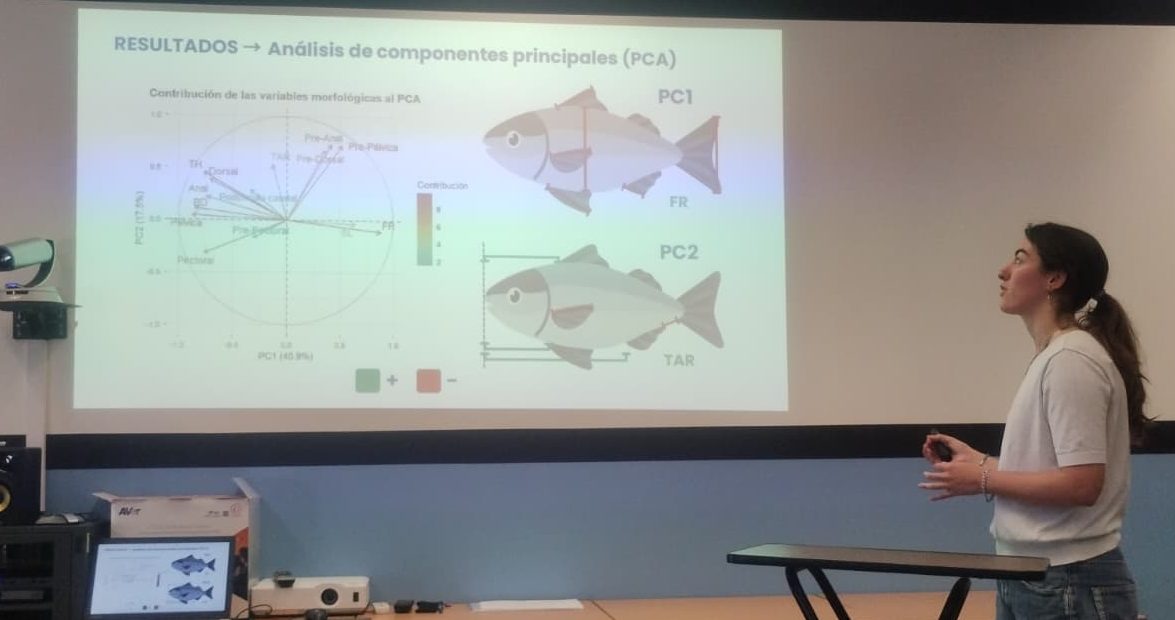
Knowledge about fish swimming performance and their capability to overcome barriers (passability) is biased towards economically important migratory species like salmonids. However, fish are more than salmon and barriers to free flow in rivers also impact the dispersal of other species that are less studied, often poorer swimmers and less capable of overcoming barriers.
Daniela compiled information about swimming speeds of species that were available in the literature. She then measured species morphometrics from photographies of fish with ImajeJ (now Fiji) obtaining information about fish shapes, their slimness or tail surface area.
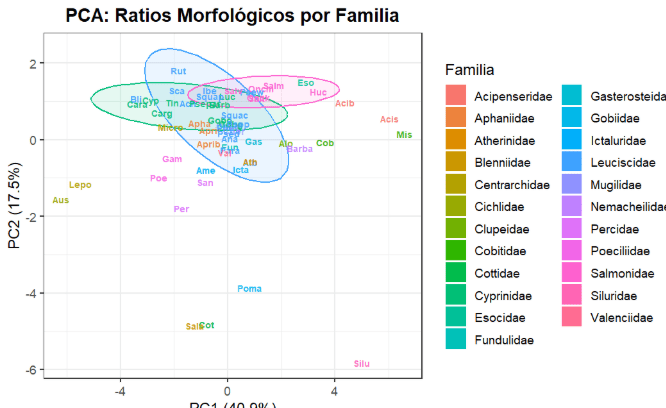
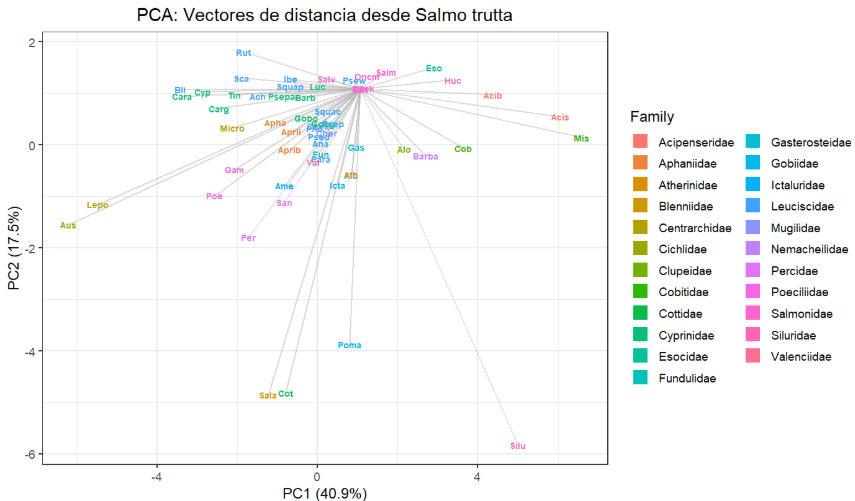
Freshwater fish species clustered together depending on key morphometrical measurements in a two-dimesnional Princiopal Component Analysis (PCA). Generally, morphological clusters followed phylogenetic ones, even though some species were clear outliers, even within a single family.
Then, Daniela evaluated the hability of morphological measurements to predict swimming hability: critical velocity (Ucrit) was highly dependent on absolte total length while busrt swimming velocity (Uburst) was more dependant on morphological PCA dissimilarities. Relative (body lengths/s) swimming velocities where also considered to obtain a model that could relate morphology and swimming hability independently of absolute fish size.
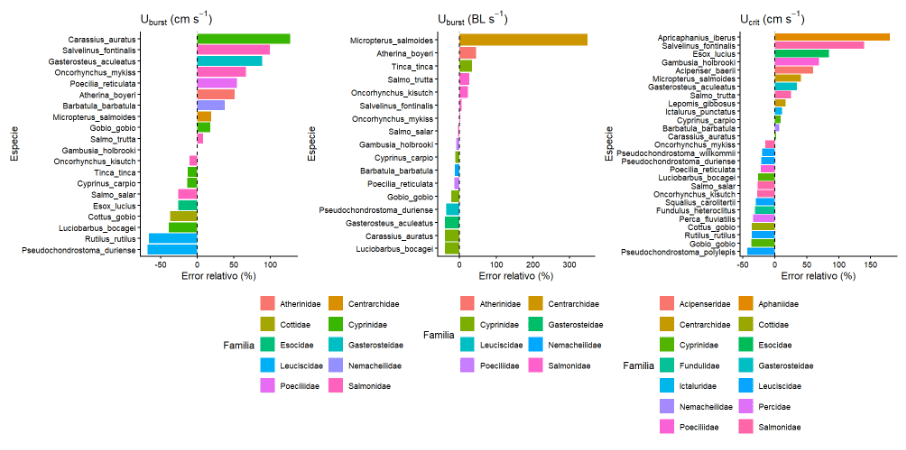
Accuracy of model-predicted swimming speeds varied across species and velocity measurements (Ucrit, Uburst, relvative, absolute). The models both over- and under-estimated swimming performance of certain species.
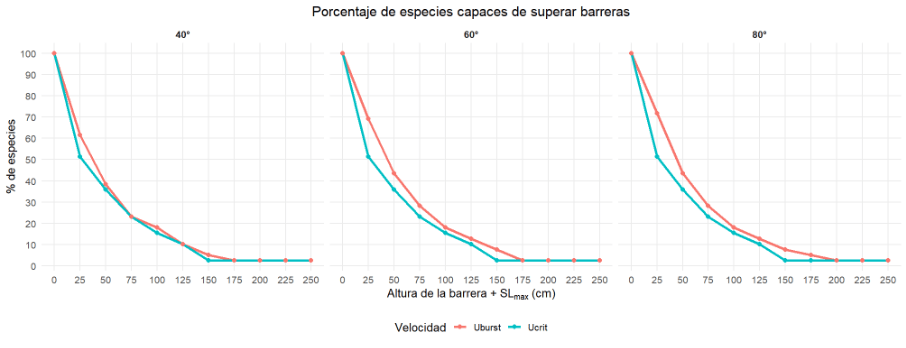
Predicted swimming speeds were then used to obtain leaping performance to determine impassable barrier heights for each species. At several leap outbreach angles, the predicted maximal barrier hieght passable was considerably low, with only around 10% of species in Spain being able to overcome obstacles above 1m.
This study explored the strategy of predicting fish swimming and leaping performance to derive upstream barrier passability thresholds for species for which hability to overcome obstacles is unknown. Findings highlight that even low-head barriers can present impassable obstacles to fish dispersal.

